The aim of this article is to shed light on how the Al-Qadsiah presence developed in the digital field. It is easy enough to archive that presence in the press, or in the dawaween — the sitting rooms where people talk — but the digital activity has been neglected, even though it has lately come to occupy the largest share of what is drawn between the club and its public. My own twenty years of taking part in that space have been an opportunity to write down some of the history that documents this activity.
Background
The roots of the internet in Khobar go back to the late Fahd Al-Afaleq, who ran an electronics shop in the Al-Shu'la complex. In 1989 Al-Afaleq was the first to set up a service called a small electronic bulletin board (BBS) — a service that links computers over a modem and allows short messages or advertisements to be posted, or even articles and chat services, within a network among those connected through the server (which is the machine itself). This system was an internet before the internet, and it caught the attention of Haitham Bouaisha and his companion at the University of Petroleum, Qais Al-Issa, who set up a BBS called Sahara. Between 1989 and 1994 the number of BBS users in Khobar and the Eastern Province grew from dozens to around 400. Bouaisha describes the board as having carried a number of topics: a section for cars, one for discussion, one for selling goods. The presence of Aramco may have helped raise awareness of the service, since the BBS was used there too for buying and selling.
What was passed around on the BBS in the early nineties was never archived, but we cannot rule out that sporting material appeared on these primitive forums, and it is possible that some Qadsiah supporters used the service — particularly given how much more prominent it was in Dhahran and Khobar during that period.
By 1994, Sahara decided to turn the BBS into a website and an internet service provider, linking the BBS server to an American company and registering the Sahara site on the World Wide Web. This shift came before the internet was formally legalised in the Kingdom; Bouaisha notes that Sahara established the internet for other Saudi sites such as Saudi Chevron and the Banking Institute in Riyadh.
The digital presence of Qadsiah supporters
The beginning of Qadsiah supporters on the internet was not organised; their presence was scattered. Yasser Al-Rajeh recalls a story about a forum owned by Hatem Al-Mishal from the year 2000 (most likely called Al-Hadaf Al-Saudi, ksagoal.com), and that Al-Rajeh went there to post a topic about Al-Qadsiah's win over Al-Ittifaq, which provoked the Ittifaq supporters on the forum. The story shows Qadsiah activity on the internet happening individually.
Unlike Al-Hilal, Al-Nassr, Al-Taawoun, Al-Raed, Al-Ittihad and Al-Ahli, which had official sites, the Al-Qadsiah board under Jassim Al-Yaqout did not establish an official site until 2005 — a late step.
The first Qadsiah site on the internet
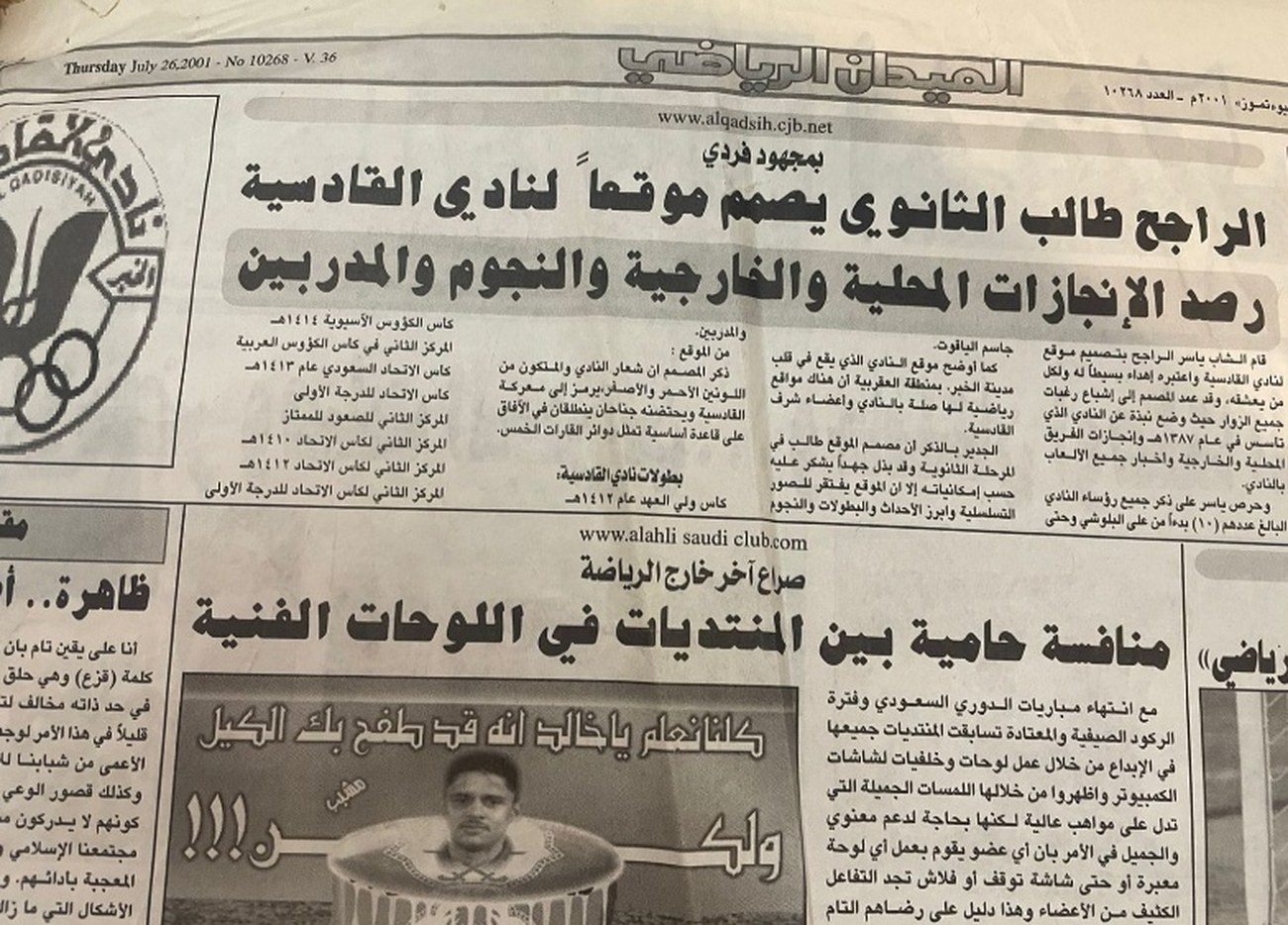
The first Qadsiah site on the internet was founded in 2001 by Yasser Al-Rajeh, when he was still a secondary-school student. Although no archived material from the site was available, an article in the newspaper Al-Yaum in the summer of 2001 documents some of its contents:
It included a survey of all ten presidents of Al-Qadsiah club, from Ali Al-Balushi through to Jassim Al-Yaqout.
It included a survey of the club's site and other sites belonging to the club and to its honorary members.
It also carried news of the first team and of every sport.
The newspaper quoted the site's description of the club crest: made up of the two colours red and yellow, symbolising the Battle of Qadisiyyah, embraced by two wings setting out towards the horizons on a foundation representing the circles of the five continents.
The site also set out Al-Qadsiah's achievements in football, and its most prominent stars and coaches.
The Qadsiah Newspaper on the Kooora forums
The most prominent activity by Qadsiah supporters was on the Qadsiah newspaper in the Kooora forums. At first there was individual activity, such as a Qadsiah member called The Gonner offering congratulations on the win over Al-Ahli and betting that Al-Qadsiah would reach the semi-final square, in the 2004–2005 league.
But as Al-Qadsiah's level improved, the Qadsiah newspaper appeared for the first time in the Kooora forums (the newspaper did not exist before 21 January 2005). Broadly, the job of these newspapers was to gather the team's news and to discuss it. The founding members were:
Editor: Al-Saree'
First deputy: Sindbad Al-Ahli
Second deputy: Hawayel
In the following issue a name appeared — lastman — who over the weeks and years that followed would take over running the newspaper. This member is known as Saleh, and he is the real founder of the Kooora newspaper: from the sixth issue onwards he opened the paper himself, and The Gooner began taking part alongside him and supporting him. The original founding staff, meanwhile, remained on the masthead in name only, with no activity at all.
A description of the newspaper's content: the paper gathered Al-Qadsiah's news across every sport from every newspaper and source on the internet, and it was a way for those on the site to follow the latest about their club. Some members, Qadsiah supporters and others, took part in the discussions raised there.
By the tenth issue the paper's administrative make-up had changed: lastman became editor, the goner first deputy and Best of East second deputy. The second deputy was Yasser Al-Rajeh himself, and traces of the first site appeared in the newspaper — the same description of the club crest, which had come from that site.
The newspaper carried on covering the club's news and putting out issues through that season, and through 2005–2006 and 2006–2007. But it was stopped for lack of activity by the moderators of Kooora Saudi, and I brought it back (under the handle Qadsawi Ya Qadsawi) later in that season, tying it more closely to what was happening on the official forum and on Muntada Al-Jumhoor. It was then run by Ali Al-Qahtani (handle Mr. Qahtani), who was a flame of activity. Also active in the newspaper in that period were Ashiq Al-Qadsiah Al-Saudi (Yousef Al-Jammaz), the engineer Salman Rahimi, and a number of other members.
The official site and the official forum
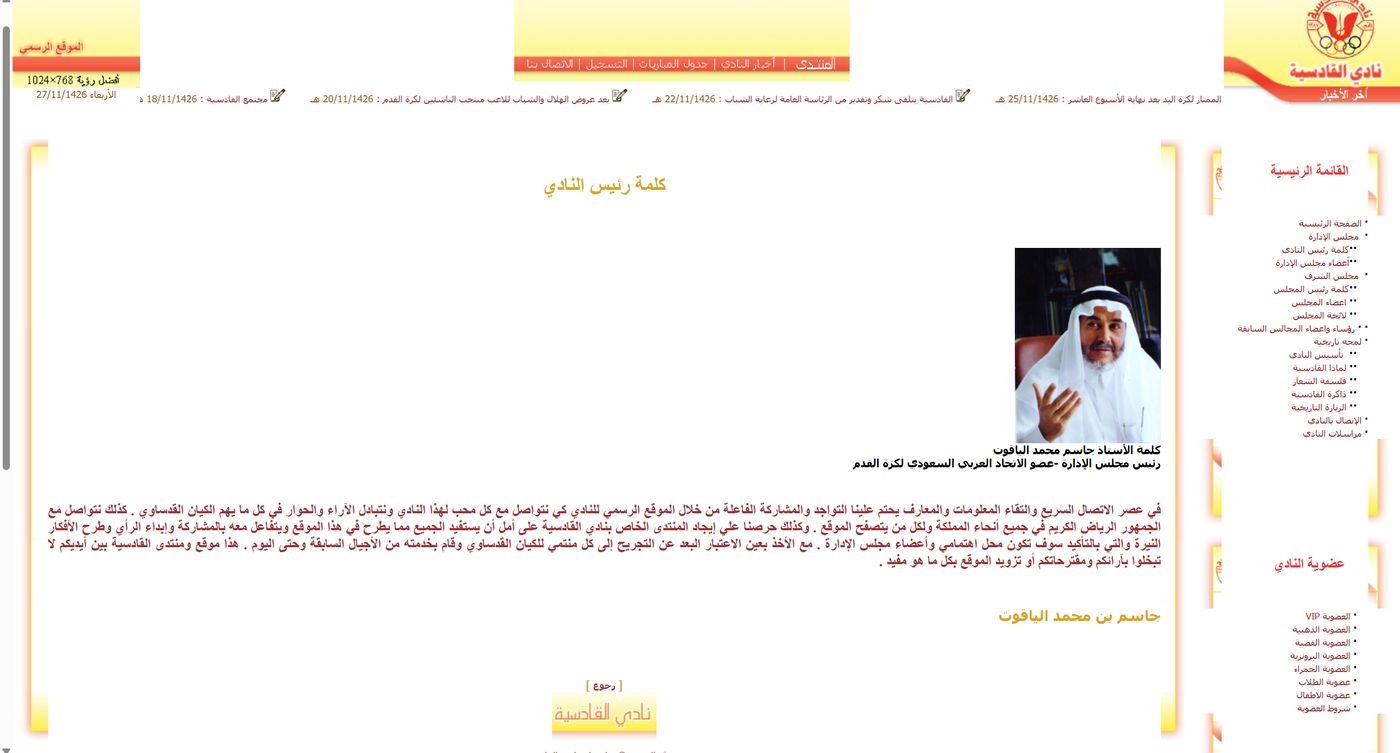
In 2005 the Al-Qadsiah board created a site for the club covering the club's services to its members, the football team's news, and news of the various teams. Broadly, the site was a fine gesture towards registering Al-Qadsiah's presence in the digital domain, and towards giving the media its voice and its coverage of the club's various teams. But the site was faulted for its backward technology, as though it had been built in 2000 rather than 2005: the pictures on it were small and did not match the size of image being loaded on the other sites in the league. The site was also poor on history, with no reference to Al-Qadsiah's major titles. It was supervised by the head of the club's media centre, Yaqoub Adam, may God have mercy on him, who knew journalism but did not keep pace with the digital shift the club needed to cover its news.
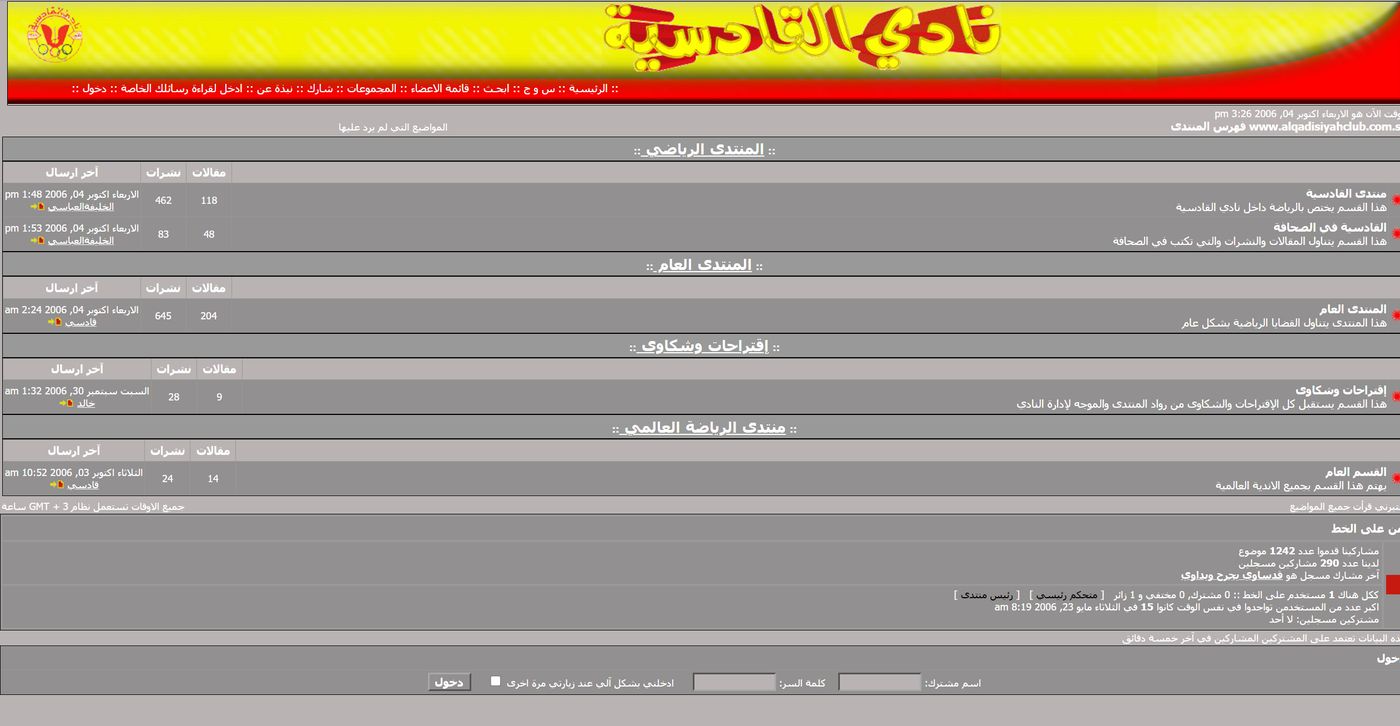
The club forum was worse from a design point of view — some Qadsiah supporters called it the cave of darkness for its dark colours. The number of members on the forum was relatively small compared with the other clubs' forums (no more than 350 members).
Nor did the forum keep up with what was happening at other clubs' forums, whether in producing daily reports, pictures or video of the matches. And the crisis that struck Al-Qadsiah after the 2006 elections, together with the first team's poor results, turned the forum into a diwaniyya for criticising the board rather than supporting the team. I do not deny that I contributed to spreading that negativity: that period was the beginning of my entry into the digital sports field (my handle then was Al-Khalifa Al-Abbasi), and I believed there was no problem at Al-Qadsiah except of the making of Jassim Al-Yaqout's board. The evaporation of the money from the Yasser Al-Qahtani transfer, the team's struggle against relegation, and the accusations of rigging in the Al-Qadsiah elections were a negative charge for many members against the board.
Even so, there was contact with the board, and that is a point in the forum's favour. The vice-president Emad Al-Muhaisen used to answer our questions there and explain why certain sports had been cancelled. As the team's level fell away at the start of the 2006–2007 season, activity on the forum fell away until it was dead, with the Qadsiah supporters deserting it for Muntada Al-Jumhoor Al-Qadsawi.
Muntada Al-Jumhoor Al-Qadsawi
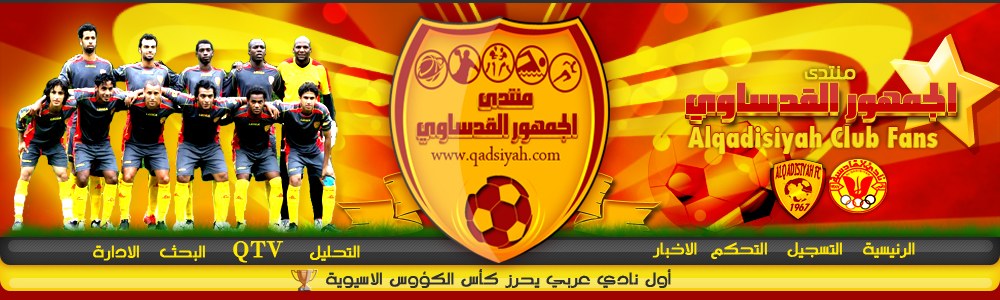
The build-up to the 2006 elections called for a stronger move by the voices supporting Ali Badghaish on the web, since the official site was “drumming” for Al-Yaqout's list rather than standing neutral. Ustadh Jamal Al-Ali put to me the idea of creating a forum where Qadsiah supporters could discuss their club's problems in complete freedom. Along the same lines, I wanted to archive videos of Al-Qadsiah's history — especially as the club had been champion of Asia, of the Crown Prince Cup and of the Federation Cup, yet such footage was entirely absent and did not exist. The strong activity of the Ittihad, Ahli, Hilal and Nassr forums in preserving the videos of their digital history pushed me to look for a platform to launch this service.
So in November 2006 I launched the Al-Jumhoor Al-Qadsawi site and forum, with the aim of raising the level of media and historical treatment. The Qadsiah supporter Fahd Al-Sayed supplied me with part of the video archive he owns, containing Al-Qadsiah's matches in the final of the Asian Cup Winners' Cup and the Crown Prince Cup, as well as the Qadsiah–Nassr match in the golden square of 2003. A year later I launched a YouTube channel for the site (in July 2007), and the channel is still going, still adding everything to do with the archive of Al-Qadsiah and Saudi football. But because I left for the United States to study (and I was under 18 at the time), I entrusted the forum to an active group of Qadsiah young men of the new generation, such as:
- Tariq Ridha'i
- Salman Rahimi
- Yousef Qutb
- Yousef Al-Jammaz
- Ali Al-Qahtani
- Abdulaziz Al-Dosari
- Ahmed Al-Ghuwainem
- Abdulaziz Al-Battah
- Yasser Al-Rajeh
The national coach Abdullah Ghali Al-Khalidi joined the forum and provided technical analysis of every Al-Qadsiah match. This team volunteered in the service of the club and used mobile-phone cameras to cover the matches. One of the strengths of Muntada Al-Jumhoor was its wish to connect the players with the Qadsiah public: I arranged with one of the shops to make shields to be given as token gifts to the players the public voted best in a match. The first shield was sent to the player Hani Al-Owaid. Most of Al-Qadsiah's players thus became followers of the forum and members of it.
Ali Al-Qahtani played a large part in designing the members' avatars, which were pictures and clipped frames from the matches of the golden generation that members could use.
Then, on my return from America to Khobar in 2008, Al-Qadsiah moved towards a new general assembly between Khalid Al-Qasim Al-Dosari and Adel Al-Muqbil. The forum sought to keep its neutrality, but in the end the greater support was for the Al-Muqbil wing, and I conducted an interview with him and published it on the forum. In the midst of this, the General Presidency for Youth Welfare issued an order appointing Abdullah Al-Hazzaa as president in place of Al-Muqbil, in a shocking decision. Al-Hazzaa sought to use the forum's platform to address the Qadsiah public, and asked me to volunteer with the new board as deputy head of the media centre — so the forum became, unofficially, the forum of the club's board. At that point I bought a camera out of my own pocket to raise the quality of coverage of matches and training.
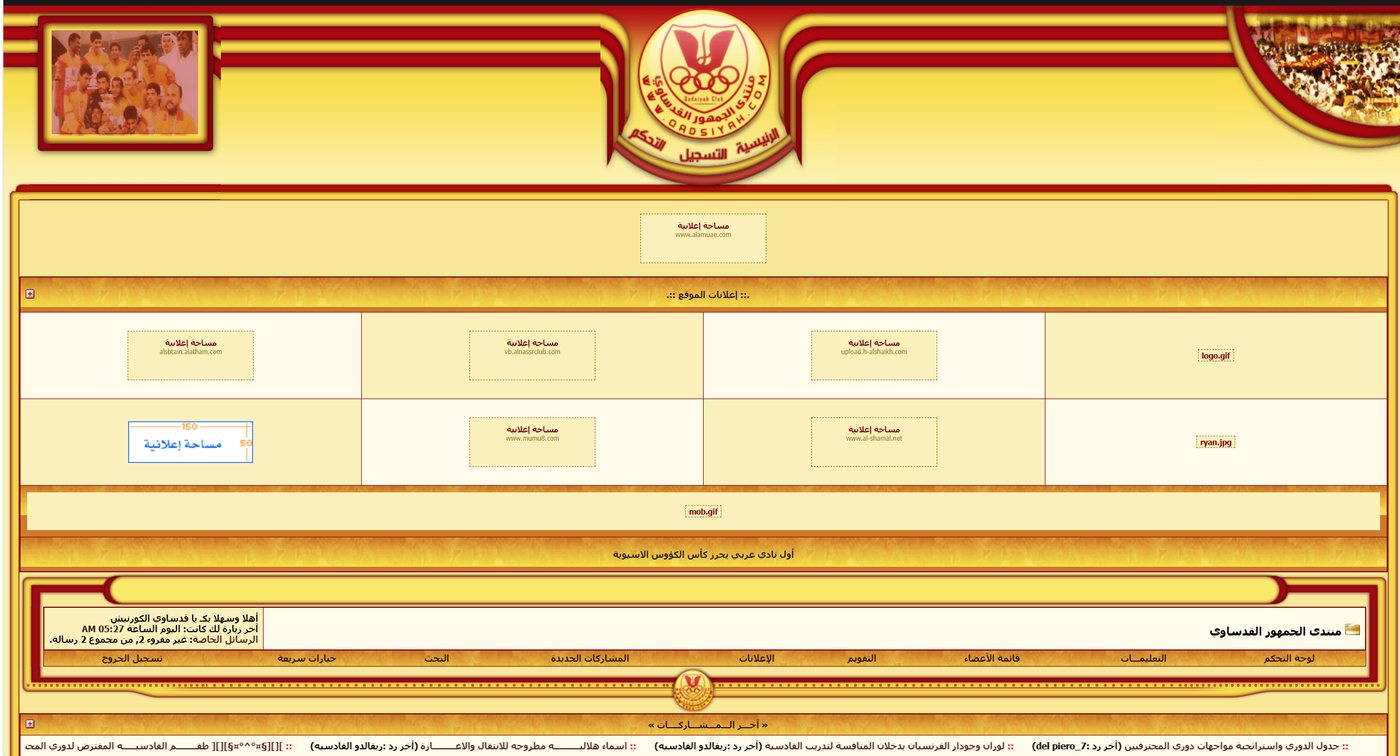 The Qadsiah Forum, 2009." loading="lazy">
In the following season (2009–2010), criticism from the Qadsiah public of Abdullah Al-Hazzaa's board and of Abdulwahab Al-Zahrani grew, because of the poor signings and the modest level of the football team after its promotion. Al-Zahrani threatened to close the forum, which pushed me to take the story to the journalist Ali Al-Qattan at Al-Yaum, who used it to expose the board's practices.
The forum also became a refuge for some Qadsiah journalists, such as Hamad Al-Sagheer, may God have mercy on him, to uncover what was hidden from the Qadsiah public. So by 2010 the forum had become the strongest instrument on the Qadsiah scene, digital or diwaniyya.
But at the start of 2010 I went back to the United States to study, and left the forum to the moderators; I neglected to follow it, until I decided not to renew it because of the rehabilitation it needed — and this despite the objection of my fellow moderators. So the forum's end came in 2013.
Even so, the forum's presence survived on the Twitter account and on the YouTube account (although the Twitter account became inactive). The YouTube channel, which I still run, has become one of the oldest accounts documenting the history of Saudi sport, and by 2026 the channel had reached around 5,000 subscribers. Unlike the policy of TikTok and short-form video, which concentrates on views, the channel's focus is not reach but documentation, with the aim of providing enough material for researchers and followers in the years to come. That is why the channel has concentrated since 2024 on uploading full matches, which has built it a steady daily following even when it is not active. The channel has also gone beyond concentrating on Al-Qadsiah alone, and has documented most of the clubs.
The official Al-Qadsiah club forums
This forum was created in late 2010, and its aim was to put the weight of the Al-Qadsiah board behind an official forum that would pull the rug from under Muntada Al-Jumhoor Al-Qadsawi. But broadly the forum did not find acceptance, because it relied on journalists and club employees rather than on the Qadsiah public. And then the internet itself saw a change in its nature towards Web 2.0, with attention shifting to social media at the expense of forums.
The rise of the groups
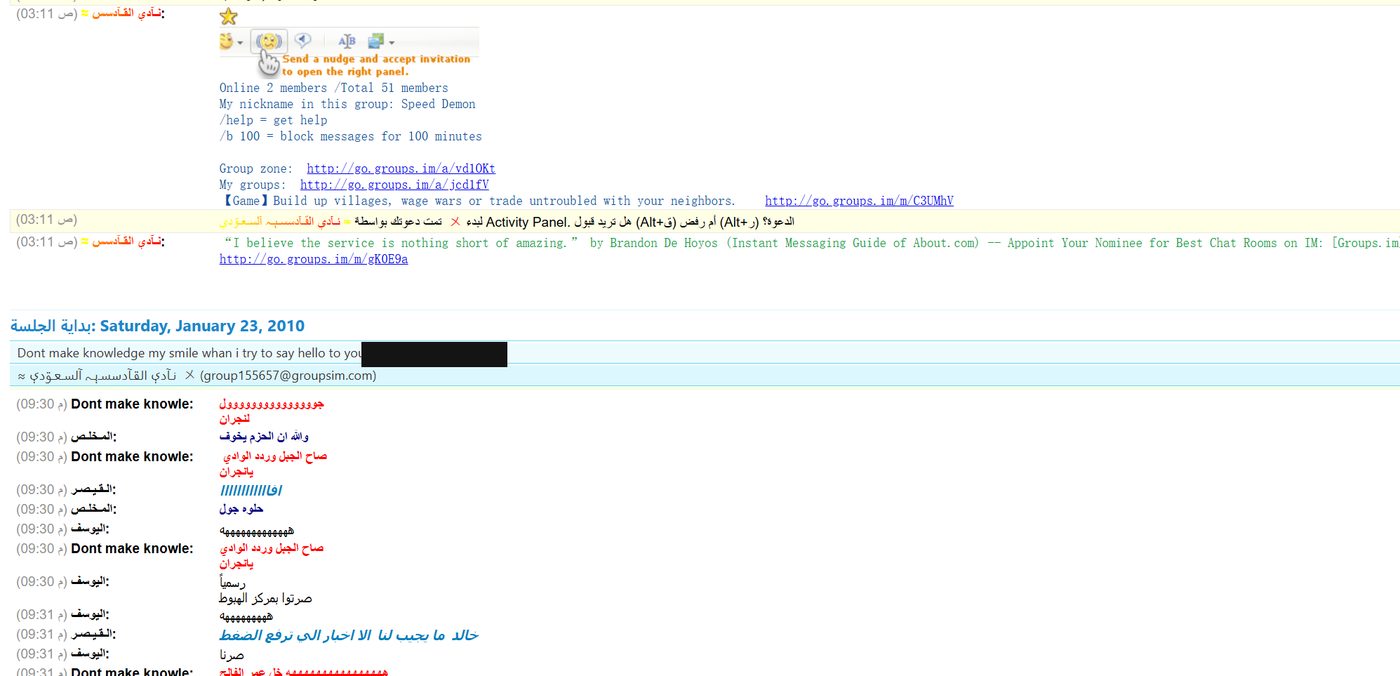
In 2009 MSN Messenger launched a feature for creating groups, which prompted Yousef Al-Jammaz to open a group in July 2009 for Qadsiah supporters from the Qadsiah newspaper on Kooora and from Muntada Al-Jumhoor Al-Qadsawi. The groups were a way of talking privately instead of the forums' style, open to readers, and so joking and banter tended to prevail. The group's membership grew to more than 50 subscribers by 2010.
In 2015 new groups appeared on WhatsApp, which became the preferred application for the ease of exchanging data and messages in it. The appearance of the groups democratised the Qadsiah community: many former players and long-standing, well-regarded supporters became active in the affairs of their club.
Among the most prominent groups:
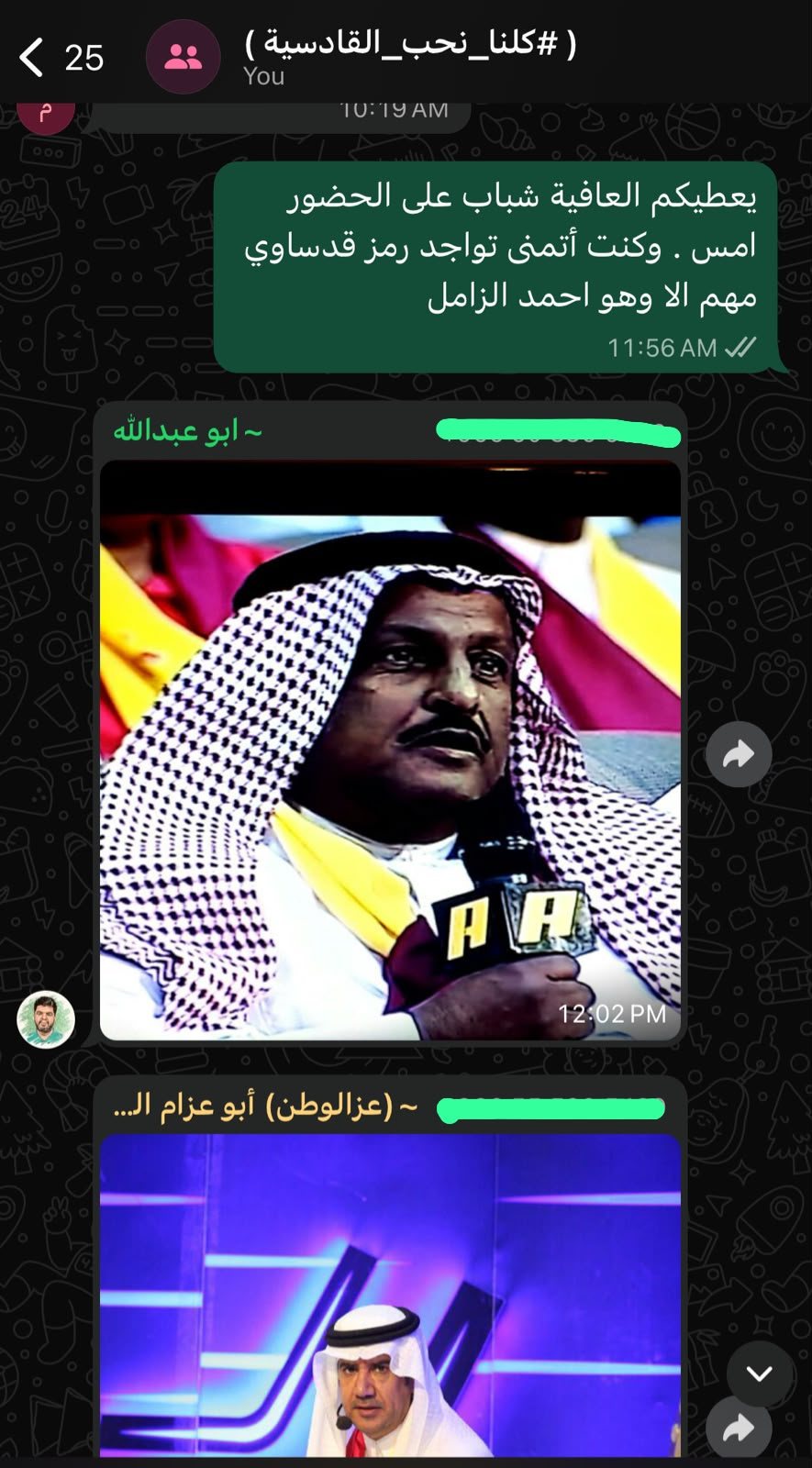
Kullina Nuhib Al-Qadsiah (“We All Love Al-Qadsiah”), founded in February 2015 by Mohammed Assaf Al-Humaidani. The most prominent and well-regarded Qadsiah supporters are active in it, such as Uncle Jamal Al-Ali, and former administrators such as Ghuloom Mohammed, along with a large number of former players and administrators. But this group tends to suffer from its size and its lack of organisation. It has been reproduced in several forms over the years.
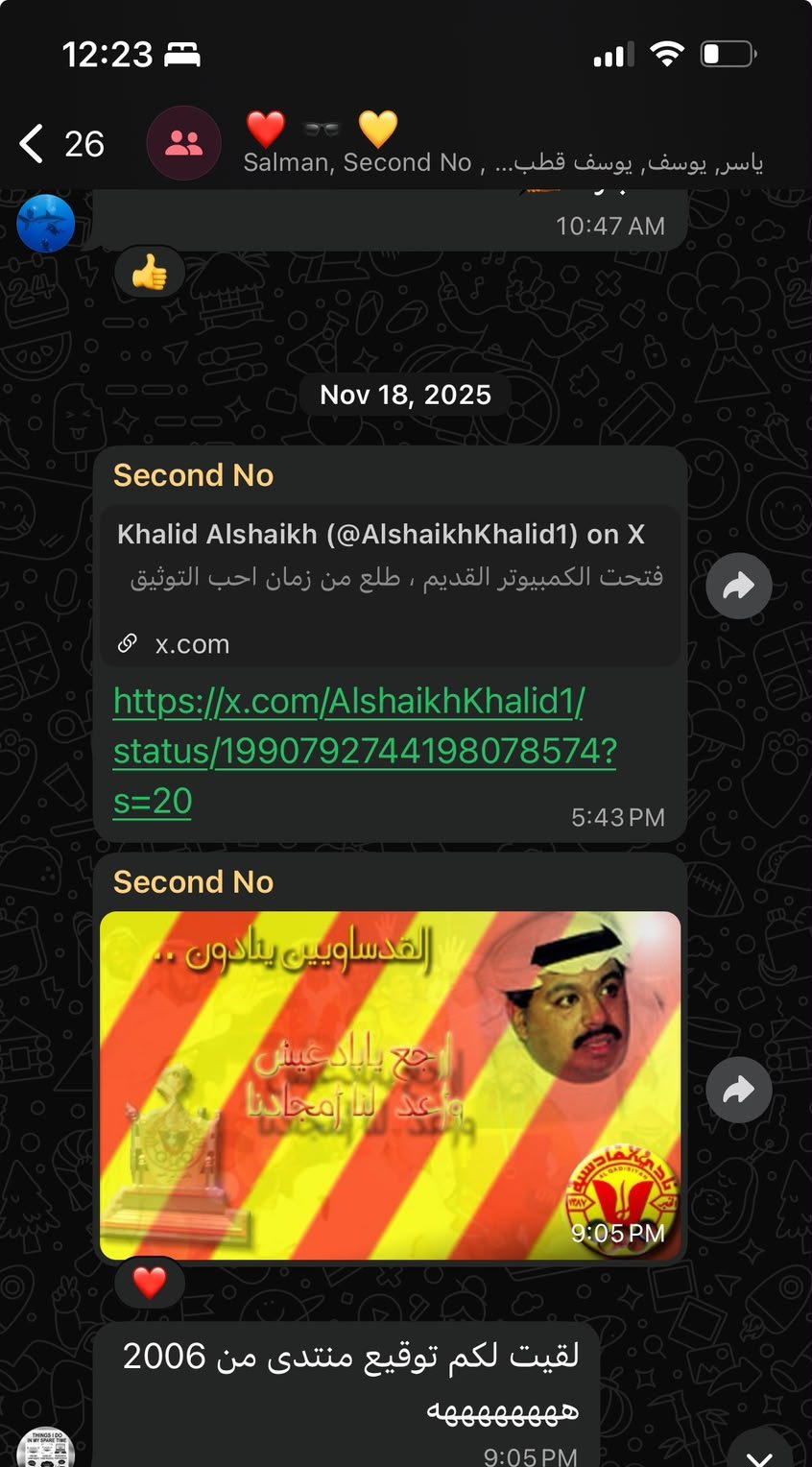
Al-Jumhoor Al-Qadsawi: this group is small (no more than 30 members), most of them from the generation that helped create the forum. It was set up by Yousef Al-Ghunaim, and I took on supervising it as well. The group is still going, despite passing through years of weak participation, and it is largely concerned with organising the distribution of tickets and with discussing subjects to do with the club and the team openly, in the manner of Muntada Al-Jumhoor. Its members have also organised the defence of the club and its history on the Twitter platform.
Minbar Al-Qadsiah on X
A new phenomenon that has emerged in recent years is the appearance of unofficial “minbar” accounts, whose aim is to give exclusive coverage as well as to create excitement. A person called Fahd founded Minbar Al-Qadsiah, but ownership soon passed to Anad Al Dhawi (son of the late Qadsiah supporter and player Ali Al Dhawi). The minbar has succeeded in building a large presence among followers, as well as increasing its reliability as a news source for sports followers, and it is considered the largest unofficial Qadsiah platform.